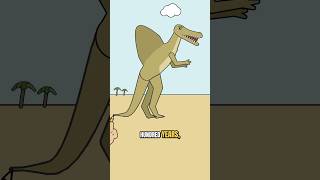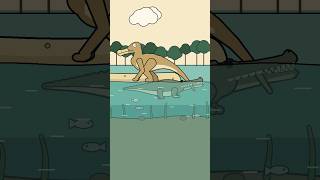
This Crocodile Hunted Dinosaurs
Description: Deinosuchus, the giant crocodile cousin, and the dinosaur bones that carry its tooth marks
Deinosuchus, the "terror crocodile", lived about 82 to 73 million years ago in the estuaries and along the coasts of what is now the United States and northern Mexico, more than ten million years before Tyrannosaurus rex. It left its signature in other animals: blunt, dimpled dents that paleontologist David Schwimmer first noticed in sea-turtle fossils from Georgia and later saw in dinosaur bones from Big Bend, Texas, and at the New Jersey State Museum. Its front teeth were pointed cones; the ones at the back were low, thickly enameled crushers. A 2025 study puts the larger species at about 7.7 m, less than the 8 to 12 m of earlier estimates, and places the animal on a branch that split off before living crocodiles and alligators parted, which is why the Short says cousin. What a dent cannot tell you is whether the animal it was pressed into was still alive, and the Short's second half turns on that.
0:00 Holding prey your own size
0:30 The tail and the fossil bones
All Gone Animals Shorts: https://www.youtube.com/playlist?list=PLfZ2odR62pH8
Sources and caveats
- Schwimmer D.R. 2010, New Mexico Museum of Natural History and Science Bulletin 51:183-190 (abstract only): https://csuepress.columbusstate.edu/bibliography_faculty/115
- Handwerk B., National Geographic, 25 Mar 2010: https://www.nationalgeographic.com/animals/article/100323-giant-croc-crocodile-dinosaurs-deinosuchus-feces-poop
- Walter et al. 2025, Communications Biology 8:611 (abstract and results read): https://pmc.ncbi.nlm.nih.gov/articles/PMC12018936/
- University of Tübingen release, 25 Apr 2025: https://uni-tuebingen.de/en/university/news-and-publications/press-release/dinosaur-eating-giant-crocodile-thrived-due-to-saltwater-tolerance/
- Witton M., blog post, 22 Jan 2016: https://markwitton-com.blogspot.com/2016/01/deinosuchus-dalek-backed-alligatoroid.html
- Wikipedia, "Deinosuchus" and "Appalachiosaurus": https://en.wikipedia.org/wiki/Deinosuchus
- McElvogue and Lehman 2019, Geological Society of America meeting abstract: https://studio.m-anage.com/gsa/2019AM/webprogram/Paper330947.html
- 0:00 "Crocodile" and "hunted" are the title's shorthand: Deinosuchus was a relative of crocodiles, and what the fossils show is that it bit dinosaurs. The shore, the drinking, the bite on the tail, the tug-of-war, colour and skin are a reconstruction; no source describes an attack.
- 0:04 "As big as you are" follows National Geographic in 2010, when Deinosuchus was put at 29 feet. The 2025 study prefers about 7.7 m and adds that the biggest were likely larger. We found no measured length for the bitten duck-bills: the equal lengths on screen are our drawing.
- 0:07 These were earlier, smaller relatives, not T. rex. The bitten bone we can point to is a leg bone from New Jersey, from a young animal that was either Appalachiosaurus or Dryptosaurus (Wikipedia, citing a paper we did not open). National Geographic also names Albertosaurus, which we could not confirm. The animal backing away from the water is our scene.
- 0:12 The bite that only dimples the skin and slips is ours: what would go wrong, not a find. No source describes a failed bite; the sources say what the back teeth were built for.
- 0:14 Schwimmer's abstract says the back teeth "were adapted specifically for bonecrushing feeding behavior". "Short, rounded, and blunt" is Wikipedia's phrase, uncited there.
- 0:30 Tooth marks on duck-bill tail bones are reported from Big Bend, Texas (Wikipedia, citing Schwimmer 2002) and, "probably" from Deinosuchus, from Coahuila, Mexico (a 2009 paper we know through a search summary). The grab is our reading of a mark on a tail bone.
- 0:33 Not every bitten bone from Big Bend is its work: a 2019 abstract gives one heavily bitten duck-bill there to a tyrannosaur. The bones on screen are cartoons, not copies of specimens.
- 0:39 This doubt is real. Witton: "it cannot be easily established whether these animals were killed by Deinosuchus or merely scavenged by them".
- 0:42 This rests on one sentence of Schwimmer's in National Geographic: "One of the marks shows signs that the bone was healed, which means that the animal survived the bite". The article does not say which bone or which animal, and we could not open the full text of his paper. One of its figure captions, seen only in a search result, describes a healed bite on a turtle's shell, and Witton mentions healed turtle shells only. So the animal that got away may well have been a turtle, not a dinosaur, which is why it is never drawn. "Got away" is our wording for "survived".
- Pictures: every animal and place is drawn and animated in code, with no AI-generated images. Voice and music: AI-generated (ElevenLabs). Close description