Why Do Apples Turn Brown? (It's Not Rust) #shorts
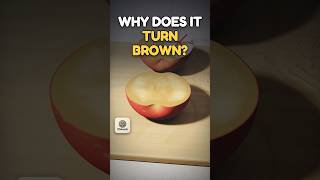
Description: Cut an apple and the white soon starts turning brown. It isn't rust, and it isn't rot.
Every apple cell keeps a browning enzyme (polyphenol oxidase, PPO) in tiny compartments called plastids, and its ingredient, phenols such as chlorogenic acid, in another (the vacuole). Cutting breaks them open: the enzyme meets the phenols and uses oxygen from the air to turn them into quinones, which then join up by themselves into brown clumps. The enzyme has copper at its heart, not iron (an apple has only about 0.12 mg of iron per 100 g), and it is a cousin of tyrosinase, the enzyme that starts the pigment in your skin and hair.
Why? Scientists think it's a defence: lab tomatoes with extra PPO had over 100 times fewer bacteria (Li & Steffens 2002), though exactly how it works is still debated. Lemon juice fights back twice: its vitamin C turns quinones back into phenols until it runs out, and its sourness (pH 2.0–2.6) slows the enzyme. A genetically engineered apple with four of its own PPO genes turned down has about 90% less PPO activity in the fruit (cleared by the US Department of Agriculture, Feb 2015).
Try it: three slices, one plain, one with lemon, one held under water. Which stays pale longest? Brown from cutting is harmless, but eat cut fruit within two hours or keep it in the fridge. An adult does the cutting. Close description