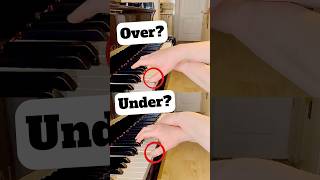
Bach Cross-Over Advice
Description: How do you know which hand goes on top?🎹 As a general rule, when playing cross-overs at the piano, the hand using the thumb goes on the bottom.
I discovered this excellent advice from Leopold Godowsky (1870-1938), in an article by Dale Haven, titled, "Notes From a Godowsky Master Class". The article appeared in the July/August 1963 edition of The Piano Teacher (pages 5-8).
In this video, you see me demonstrating Godowsky's advice, in the opening (m. 1-4) of the Giga (7th and final movement) from Partita No. 1 in B-flat major, BWV 825 (1726) by J.S. Bach. You can see that I've colour-coded the hands, with the left in yellow and the right in red. In this passage, the right hand is using thumbs, and so it remains on the bottom with the left hand crossing over.
Cross-overs can occur either when both hands are playing in a similar register at the same time, or when a hand needs to play both extremely high and low material in quick succession while the other hand maintains material in the mid-region (which is the case, here.) Additionally, I have found that sometimes, at least in Bach's music, I have to rewire my fingering for the sake of clear articulation, good voicing, or what have you and so there have been times when the sheer need to adjust fingering resulted in a cross-over where, perhaps, there otherwise would not be one. As well, it can happen that when both hands are playing close together, both thumbs will be in use. In these cases, I've found that the hand with the black notes is best placed on top.
While one should not feel strictly bound by this tip (every passage is different and requires careful planning and negotiating of the various musical and technical issues), Godowsky's advice does, however, provide an excellent starting point for working out the logistics of a cross-over.
Whenever I have a cross-over to execute, or one that I'm creating in order to improve clarity, I think of Godowsky's advice. My teacher, Constance Keene, knew Godowsky and was rather fond of him. He used to have great parties and everyone would call him "Popsy".🥰
This stuff is all about ergonomics, getting the keyboard topography of a given passage to fit the hand by making carefully thought-out decisions. Godowsky's advice has served me well since I encountered it years ago, and, hopefully, it will help you, too!
Godowsky photo via https://classical-pianists.net/2025/04/06/leopold-godowskys-berlin-debut/
Sheet music for Bach's Partita No. 1: https://ks15.imslp.org/files/imglnks/usimg/b/bf/IMSLP00789-BWV0825.pdf
Thank you, channel members!!❤️🎹
If you enjoy this content, then please subscribe. Your comments and likes are also appreciated. Thank you!
If you are able and would like to help me continue making content devoted to Mr. B, you can join my channel!🎉 Membership is monthly and you can cancel at any time. To join, please click the "Join" button at the top of my channel's homepage (right next to the "Subscribe" button.) A description of the perks I'm offering will appear, which, if you like, you can then proceed to sign-up. Thank you so much for your support and for watching my videos!🥰
You can also support my channel by "buying me a coffee" over on my Ko-Fi page: https://ko-fi.com/pennyjohnson Thank you so much for your support!☕️🎵
To find out more about me, please visit my website: https://www.pennyjohnsonpiano.com
To purchase a copy of my recording of the complete Inventions & Sinfonias of Bach, please visit: https://music.apple.com/ca/album/j-s-bach-inventions-sinfonias-bwv-772-801/1309335935 (Also available on Amazon).
To purchase my arrangement of J.S. Bach's 15 Two-Part Inventions, for inverted voices, please visit: https://www.sheetmusicplus.com/en/product/complete-two-part-inventions-bwv-772-786-with-inverted-voices-20689080.html Close description