T. Rex Never Roared
Description: What T. rex really sounded like, and where the famous movie roar actually came from
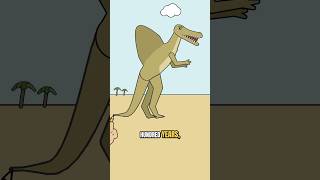
The roar everyone knows was built for Jurassic Park by sound designer Gary Rydstrom. He has said its high scream is a baby elephant laid over something low like a tiger; a later account adds an alligator's rumble. No fossil is known to record a dinosaur's voice, so the case rests on relatives and on one ear. In 2016 Tobias Riede, Julia Clarke and colleagues surveyed 208 bird species and found 52 that call with the beak shut, the sound leaving through the skin of a swelling neck, as when a dove coos. Crocodilians have closed-mouth calls too, such calls favour low pitch, and the authors think some dinosaurs probably made them. Seven years earlier, CT scans of tyrannosaur braincases, Tyrannosaurus rex among them, had shown a long cochlea, read as hearing weighted toward low sounds. The Short gives you the animal's body and one job, being heard across a floodplain, and lets the elephant and the cat fail you first.
0:00 The movie roar and its three animals
0:26 What its living relatives do
All Gone Animals Shorts: https://www.youtube.com/playlist?list=PLfZ2odR62pH8
Sources and caveats
- Riede T. et al. 2016, Evolution 70(8):1734-1746: https://academic.oup.com/evolut/article/70/8/1734/6851892
- University of Texas release on it, 11 Jul 2016: https://news.utexas.edu/2016/07/11/dinosaurs-may-have-cooed-like-doves
- Witmer and Ridgely 2009, The Anatomical Record 292:1266-1296 (abstract only): https://people.ohio.edu/witmerl/Downloads/2009_Witmer_&_Ridgely_tyrannosaur_brains_&_ears.pdf
- Ridgely and Witmer, SICB meeting abstract (the skulls scanned): https://sicb.org/?p=30888
- Sullivan B., NPR, 13 Apr 2013 (read via NHPR): https://www.nhpr.org/2013-04-13/jurassic-bark-how-sound-design-changed-our-imaginations
- Meenan D., SlashFilm, 11 Jun 2023: https://slashfilm.com/1310511/jurassic-park-got-t-rex-from-combination-of-three-different-animals
- Reber et al. 2017, Scientific Reports 7:1816 (alligator bellows): https://pmc.ncbi.nlm.nih.gov/articles/PMC5431764
- University of Utah release on lion and tiger roars, 2011: https://www.sciencedaily.com/releases/2011/11/111102190012.htm
- Wildlife Conservation Society release on cassowary booms, 2003: https://www.sciencedaily.com/releases/2003/10/031028060039.htm
- Powell D., Science News, 24 May 2011: https://www.sciencenews.org/article/gators-go-courtin-fancy-physics
- Switek B., Audubon, 14 Jul 2016: https://www.audubon.org/magazine/hoot-goes-t-rex
- Borish N., Lee C., Carnegie Museum of Natural History, 24 Jun 2021: https://carnegiemnh.org/what-did-dinosaurs-sound-like-paleoacoustics
- Yoshida et al. 2023, Communications Biology 6:152 (a fossil voice box, but of the armoured Pinacosaurus, not a tyrannosaur): https://pmc.ncbi.nlm.nih.gov/articles/PMC9932143
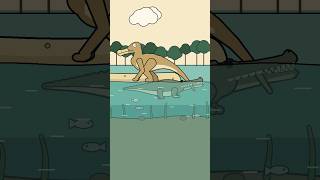
- 0:00 "Never" is the title's word: the sources say probably, and the 2016 paper thinks dinosaurs likely made open-mouth sounds as well. The squeal and the silent roar are what would go wrong, not finds. The swollen throat and leaping puddle of the first frame are borrowed: see 0:29.
- 0:03 Rydstrom names the baby elephant and a tiger; the alligator comes from SlashFilm, where the cat is a tiger or a lion.
- 0:10 No source says why, or whether, a Tyrannosaurus called over distance. Living birds use closed-mouth calls mostly for mates and territory.
- 0:15 This rests on alligator bellows: being very low cuts their loss over long distances.
- 0:18 A lion's or tiger's roar depends on flat, square vocal folds. No source says a Tyrannosaurus lacked them; its silent open mouth is our picture.
- 0:26 "Can": birds and crocodilians call with open mouths too. The study says some dinosaurs and never names Tyrannosaurus; that step is Audubon's and a Carnegie Museum education page's. Only the dove calls here; our sources do not say an alligator bellows with its mouth shut.
- 0:29 The swollen throat is borrowed from birds; Clarke's words are that dinosaurs "may have had bulging necks". "Felt more than heard" is reported of cassowary booms close up and of alligator rumbles, which also make water jump on a male's back: the leaping puddle is borrowed from that. The release calls closed-mouth calls often much quieter, so deep is not loud.
- 0:38 The long part is the cochlea. With air spaces round the middle ear, the authors infer an emphasis on low-frequency sounds: an inference about hearing from anatomy, not a test, and not proof of the call. The skull drawn is no named specimen.
- Colour, skin and the drawn sound shapes are a reconstruction.
- Pictures: every animal and place is drawn and animated in code, with no AI-generated images. Voice and music: AI-generated (ElevenLabs). Close description