How Does a 116-Metre Tree Drink Without a Pump? #shorts
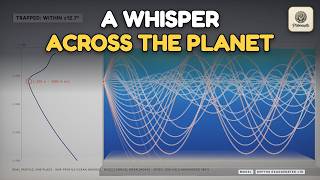
Description: The best suction pump in the world can only lift water about 10 metres. The tallest known tree on Earth, a coast redwood called Hyperion, lifts it about 116 metres, with no heart and no pump.
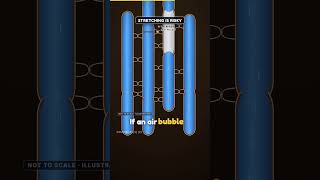
The trick: water is pulled from the top, not pushed from the bottom. Water evaporates from the leaves (transpiration), and because water molecules cling together, the pull travels down an unbroken thread of water in the xylem, all the way to the roots. The water inside a tall tree is literally stretched: at the top of a giant redwood it's pulled about 20 times harder than any pump can manage. The risk is an air bubble that snaps the thread, and that, together with gravity, is why one big study estimates redwoods could top out at about 122–130 m.
Narration: Vrishvardhan, in his own voice, cloned.
Every claim in this video is backed by the sources below.
Sources:
[1] Koch, G. W., Sillett, S. C., Jennings, G. M. & Davis, S. D., The limits to tree height, Nature 428: 851–854 (2004), doi:10.1038/nature02417 https://pubmed.ncbi.nlm.nih.gov/15103376/
[2] Clark, Douglas & Choi, Biology 2e §30.5 Transport of Water and Solutes in Plants, OpenStax (2018) https://openstax.org/books/biology-2e/pages/30-5-transport-of-water-and-solutes-in-plants
[3] Sperry, J. S., Hydraulics of Vascular Water Transport, in Wojtaszek (ed.) Mechanical Integration of Plant Cells and Plants, Springer (2011), pp. 303–327 https://sperry.biology.utah.edu/publications/Sperry%20cohesion-tension%20review.pdf
[4] Tyree, M. T. & Sperry, J. S., Vulnerability of xylem to cavitation and embolism, Annu. Rev. Plant Physiol. Plant Mol. Biol. 40: 19–38 (1989), doi:10.1146/annurev.pp.40.060189.000315 https://sperry.biology.utah.edu/publications/Tyree_Sperry%201989%20ARPPMB.pdf
[5] Ha, Morrow & Algiers, Botany §4.5.1.3 Cohesion–Tension Theory, LibreTexts (adapted from OpenStax and Kimball) https://bio.libretexts.org/Bookshelves/Botany/Botany_(Ha_Morrow_and_Algiers)/04:_Plant_Physiology_and_Regulation/4.05:_Transport/4.5.01:_Water_Transport/4.5.1.03:_Cohesion-Tension_Theory
[6] Guinness World Records, Tallest tree – living (Hyperion, 116.07 m by 2019) https://www.guinnessworldrecords.com/world-records/tallest-tree-living
[7] Humboldt State University News, HSU Prof Confirms World's Tallest Tree (1 Oct 2006) https://now.humboldt.edu/news/hsu-prof-confirms-worlds-tallest-tree
[8] NBC News / Reuters, Redwood confirmed as world's tallest tree (29 Sep 2006) https://www.nbcnews.com/id/wbna15066332
[9] Trinity College Dublin Botany, Henry Horatio Dixon (on Dixon & Joly, On the ascent of sap, Phil. Trans. R. Soc. B 186, 1895) https://www.tcd.ie/botany/about/tercentenary/300-years/henry-horatio-dixon/
[10] Nave, R., HyperPhysics: Pressure measurement / barometer, Georgia State University https://hyperphysics.gsu.edu/hbase/pman.html
[11] Ambrose, A. R. et al., Effects of height on treetop transpiration and stomatal conductance in coast redwood, Tree Physiology 30: 1260–1272 (2010), doi:10.1093/treephys/tpq064 https://pubmed.ncbi.nlm.nih.gov/20631010/
[12] Ambrose, A. R., Sillett, S. C. & Dawson, T. E., Effects of tree height on branch hydraulics, leaf structure and gas exchange in California redwoods, Plant Cell Environ. 32: 743–757 (2009) https://pubmed.ncbi.nlm.nih.gov/19210642/
[13] Nature News, Tallest trees reach their limit (19 Apr 2004), doi:10.1038/news040419-5 https://www.nature.com/news/2004/040419/full/news040419-5.html
[14] NBC News / AP, Even tallest trees have limits, study says (2004) https://www.nbcnews.com/id/wbna4798747
[15] Fisher, J. B., Angeles, G., Ewers, F. W. & López-Portillo, J., Survey of root pressure in tropical vines and woody species, Int. J. Plant Sci. 158 (1997) https://epublications.marquette.edu/liana_articles/386
[16] Wullschleger, S. D., Meinzer, F. C. & Vertessy, R. A., A review of whole-plant water use studies in trees, Tree Physiology 18: 499–512 (1998), doi:10.1093/treephys/18.8-9.499 https://pubmed.ncbi.nlm.nih.gov/12651336/
[17] Miller, D. M., Studies of root function in Zea mays III: xylem sap composition at maximum root pressure…, Plant Physiology 77(1): 162–167 (1985) https://pmc.ncbi.nlm.nih.gov/articles/PMC1064475
Credits:
- Diagrams and animations: drawn in code from the published numbers
- Narration: Vrishvardhan, in his own voice, cloned Close description