Turtles Started With Half a Shell
Description: Odontochelys, the toothed turtle with half a shell: how turtles got their shell
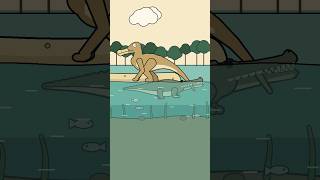
Odontochelys semitestacea, "toothed turtle with half a shell", was described in 2008 by Li Chun and colleagues from three skeletons found in Late Triassic marine rock near Guanling in Guizhou, China. It was about 35 cm long, with small peg-like teeth where living turtles have a beak. Its plastron, the belly plate, was complete. Its back had no shell of bone, only bony outgrowths along the backbone and ribs that had begun to broaden. The describers took that as a shell caught half built and noted that the top shell of a living turtle begins the same way in the embryo, with the ribs. Reisz and Head answered in the same issue of Nature that it could be a turtle whose top shell had not turned to bone. A 2023 isotope study of two of the skeletons placed the animal in coastal sea water, probably eating seaweed.
0:00 A turtle with half a shell
0:30 A living turtle's shell, and the fossils
All Gone Animals Shorts: https://www.youtube.com/playlist?list=PLfZ2odR62pH8
Sources and caveats
- Li et al. 2008, Nature 456:497-501 (abstract only): https://doi.org/10.1038/nature07533
- Yong E., Discover, 27 Nov 2008: https://www.discovermagazine.com/planet-earth/heroes-in-a-half-shell-show-how-turtles-evolved
- Goedert et al. 2023, Frontiers in Ecology and Evolution 11 (read in part): https://www.frontiersin.org/articles/10.3389/fevo.2023.1175128
- Wong K., Scientific American, Feb 2009: https://www.scientificamerican.com/article/new-fossil-origin-of-the-turtle-discovered/
- Reisz and Head 2008, Nature 456:450-451 (not read; through Yong): https://www.nature.com/articles/456450a
- Gilbert et al. 2001, Evolution and Development 3:47-58 (abstract only): https://pubmed.ncbi.nlm.nih.gov/11341674/
- Hirasawa et al. 2013, Nature Communications 4:2107 (abstract only): https://www.nature.com/articles/ncomms3107
- Rice et al. 2016, PNAS 113:5317-5322: https://pmc.ncbi.nlm.nih.gov/articles/PMC4868452
- Schoch and Sues 2015, Nature 523:584-587, and Schoch et al. 2019, Scientific Reports (summaries only): https://link.springer.com/10.1038/s41598-019-46762-z
- Natural History Museum, London, 4 Jun 2026, on Jenkins et al. 2026, Current Biology: https://www.nhm.ac.uk/discover/news/2026/june/new-fossil-analysis-rewrites-the-origin-of-turtles.html
- 0:00 "Started" is the title's shorthand. Odontochelys is an early stage, not the first step: an older relative, Pappochelys, had thick belly ribs in place of a plate. Colour, skin, paddle limbs, rounded tooth tips, the swimming and the seaweed meal are a reconstruction.
- 0:06 The 2008 paper calls it a turtle, the 2023 paper an early stem turtle.
- 0:16 "No bony shell" is what the bones show. Whether skin or an unhardened shell covered the back is not known; the plain skin is our drawing.
- 0:21 "It lived in the sea" follows the 2023 isotopes; an earlier author thought it a land or freshwater animal. "Danger from below" is the describers' idea as Scientific American reported it, and others suggest the heavy plate was ballast for diving. No attack on it is known, and the dark shape is no particular animal.
- 0:26 The lost-top guess is close to Reisz and Head's reading, and nothing in this Short rules it out. The ribs and the embryo are the describers' argument for a shell half built.
- 0:30 "Doesn't come off" is our inference: a living turtle's top-shell plates are continuous with its ribs and backbone (2013 study). How the bone forms is debated: around each rib (2001), or from the ribs themselves (2013). Nothing here says what a line of turtles can lose over generations.
- 0:34 "Just started to widen" is Discover's wording; the paper says the ribs "are expanded".
- 0:37 The three specimens come from the Xiaowa Formation. We draw one cartoon skeleton, not a copy of any of them, and nothing we read says what each one preserves.
- 0:40 The paper says the broadened ribs and the plates on the backbone correspond "to early embryonic stages of carapace formation in extant turtles". We do not say the belly plate hardens first in the egg: Discover does, and the 2016 study found the plate and the top shell's first ridge begin together. The egg is a present-day turtle's, drawn as a diagram; no egg of Odontochelys is known.
- Left out: Eunotosaurus, long called the oldest turtle relative. The 2026 study takes it out of the turtle line, and that is disputed.
- Pictures: every animal and place is drawn and animated in code, with no AI-generated images. Voice and music: AI-generated (ElevenLabs). Close description